
Continuous data monitoring: The ROI of real-time telemetry for industrial fleets
- May 7
- 4 min read
Updated: May 19

In the complex, high-stakes world of multimodal transport and freight logistics, the difference between a profitable quarter and a logistical nightmare often comes down to one critical factor: visibility. For decades, fleet tracking meant watching a delayed GPS dot crawl across a digital map. If a truck broke down on a remote highway or a specialized transport vehicle sat idling at a port terminal for hours, fleet managers only found out after the fact. Today, however, the logistics paradigm has fundamentally shifted. We are moving away from passive tracking and entering the era of Continuous Data Monitoring powered by the Industrial Internet of Things (IIoT).
Implementing real-time telemetry across industrial fleets is no longer just a "nice-to-have" tech upgrade. It is a fundamental operational requirement. But for logistics operators and supply chain executives, the ultimate question remains: What is the actual Return on Investment (ROI) of continuous fleet telemetry?
Let’s break down how real-time data monitoring transforms raw vehicle metrics into measurable financial returns.
The High Cost of Logistics "Dark Spots"
Before we calculate the return, we must understand the cost of the void. When fleet managers lack continuous, real-time insights into their assets, they suffer from "dark spots." These blind spots manifest in several costly ways:
· Catastrophic Maintenance Failures: A minor engine anomaly that could have been fixed for $200 escalates into a blown transmission on the highway, resulting in thousands of dollars in repairs, towing fees, and missed Service Level Agreements (SLAs).
· Fuel Haemorrhaging: Unmonitored driver behaviour, excessive engine idling at container freight stations (CFS), and inefficient routing quietly drain fuel budgets.
· Asset Underutilization: In multimodal handoffs (e.g., ship-to-truck or rail-to-truck), misaligned schedules lead to assets sitting empty or stranded, severely capping revenue potential.
· Compliance Penalties: Growing environmental regulations and emission control mandates mean that poor carbon tracking can result in steep fines and revoked operational licenses.
Decoding the ROI of Real-Time Telemetry
When fleets deploy continuous IIoT telemetry, they transition from a reactive posture to a proactive, intelligent strategy. The ROI of this shift is realized across four core pillars:
1. Predictive Maintenance and Maximized Uptime
Traditional maintenance schedules are based on arbitrary mileage markers. Real-time telemetry changes this by pulling continuous On-Board Diagnostics (OBD) data directly from the vehicle's engine control unit. By monitoring vibration, temperature, RPM anomalies, and fluid levels at the edge, IIoT gateways can detect the early warning signs of mechanical wear.
The ROI: Shifting from reactive repairs to predictive maintenance reduces vehicle downtime by up to 30% and extends the operational lifecycle of multi-million dollar freight assets. You fix the asset in the bay on your terms, not on the side of the road on the cargo's time.
2. Granular Fuel Optimization
Fuel remains one of the largest variable costs for any transport fleet. Real-time telemetry doesn't just track fuel levels; it contextualizes consumption. Fleet managers receive continuous data on driver behaviour—hard braking, rapid acceleration, and, most importantly, engine idling.
The ROI: By coaching drivers based on real-time data and eliminating unnecessary idling during multimodal handoffs, fleets typically see a 10% to 15% reduction in overall fuel consumption.
3. Intelligent Multimodal Synchronization
Freight doesn't move in a vacuum. A delay at a seaport impacts the drayage truck waiting at the terminal. Continuous data monitoring allows for "service mesh" logistics. If a vessel is delayed, the telemetry system updates the ETA in real-time, allowing fleet dispatchers to dynamically reroute trucks to other revenue-generating tasks rather than having them wait idle at the dock.
The ROI: Drastically improved asset turnaround times and higher utilization rates. Your trucks spend more time hauling freight and less time waiting in queues.
4. Simplified ESG and Regulatory Compliance
With tightening state and global environmental mandates, fleet emissions are under the microscope. Continuous telemetry automates the collection of carbon emission data. Instead of manually estimating carbon footprints, fleet managers have accurate, tamper-proof data streams ready for compliance reporting and sustainability audits.
The ROI: Avoidance of regulatory fines, simplified ESG reporting, and the ability to win contracts with major corporations that demand green logistics partners.
The Solution Stack: Bridging the Gap with ThinxGrid
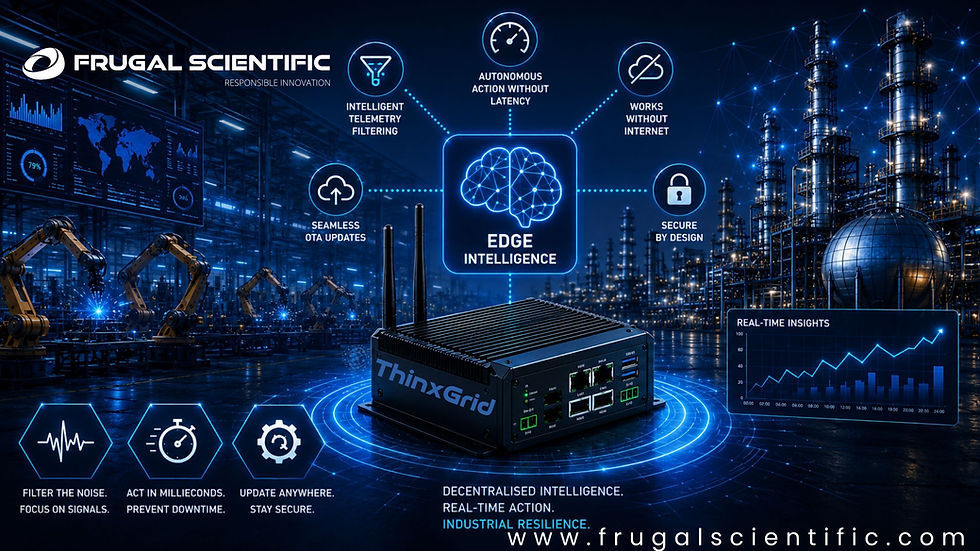
Unlocking this ROI requires more than just buying off-the-shelf trackers; it requires an intelligent data layer capable of edge processing. This is where ThinxGrid, the flagship IIoT platform developed by FrugalScientific, changes the game.
Frugal Scientific’s ThinxGrid OBD Interface Device is engineered specifically for the rigors of modern logistics. It acts as a powerful, compact Smart IoT Gateway for Vehicle Telemetry.
Here is why the ThinxGrid stack is the optimal choice for continuous data monitoring:
· Edge Intelligence: Unlike basic trackers that flood the cloud with useless data, ThinxGrid processes continuous flows of raw mechanical data locally at the source. It filters the noise and transmits high-value, actionable insights—reducing latency and cloud costs.
· Plug-and-Play Integration: ThinxGrid is designed for seamless deployment across diverse fleet assets, instantly mapping real-world mechanical data to standardized matrices for your enterprise ERP or logistics dashboard.
· Resilience & OTA Updates: Built for harsh industrial environments, ThinxGrid devices buffer data during network outages and feature Over-The-Air (OTA) updates, ensuring your fleet's telemetry is always secure and running the latest AI-driven models without manual intervention.
The Road Ahead
In the highly competitive freight industry, data is the ultimate currency. Fleets that operate in the dark are destined to be outpaced by those that harness the power of real-time insights. Continuous data monitoring via advanced IIoT telemetry is no longer the future of logistics—it is the baseline for profitability today.
Ready to transform your fleet's raw data into predictive intelligence and scalable growth?
Partner with the experts in AI-centric product engineering and Industrial IoT. Discover how the ThinxGrid ecosystem can optimize your operations and drive your ROI.


Comments